
Research and writing tools for historical and nonfiction work in 2026
How does saved research reach the draft? Explore Zotero, Scrivener, Obsidian, Notion, Aeon Timeline, and Scroll across sources, search, judgment, and citation.
In chapter fourteen, a historical novelist writes about a temporary hospital. She remembers a nurse’s diary with details about lighting, medicine, and night-shift handover. She saved the web page, downloaded a PDF, and copied one line into a note. When she needs it, search can confirm that the material exists. It cannot explain why she trusted it, which scene it supports, or whether publication requires a formal citation.
Research-led long-form work has at least four layers: preserving the source, finding its content, recording the writer’s interpretation, and deciding which claims need formal citation. A tool may go deep on one layer or bring several layers around the same writing Project. Before choosing, identify whether you are losing the file, its context, the reasoning path, or a traceable reference.
That distinction affects confidence. A missing file causes delay. An unclear chain of judgment makes a writer hesitate to state a detail. An unresolved citation boundary can follow the manuscript into editing and book production. Research tools protect more than a collection; they help the writer explain why a passage says what it says and return to the evidence when the judgment changes.
The six tools below approach that work through bibliography, long-form projects, knowledge networks, collaborative databases, time models, and the context of the current book. They are not ranked from least to most capable.
Zotero: keep sources and formal citations traceable
Zotero is a free, open-source research tool for collecting, organizing, and citing sources, including bibliography generation. For academic and nonfiction writers who need publication details, authors, titles, links, attachments, and citation data, it can become the authority for the source layer.
It answers where material came from and how to cite it under a required style. Character arcs, chapter structure, and scene tasks usually live elsewhere. A mature workflow need not ask a reference manager to plan the book; it needs a clear path by which citation information reaches the manuscript.
Scrivener: keep Research near the long manuscript
Scrivener’s Research area keeps web pages, images, PDFs, and notes beside the manuscript, while Binder organizes them in a hierarchy that reflects the writer’s understanding. Many historical writers value being able to consult material without leaving the project.
When research must also be checked against characters, places, events, chronology, and tasks across many chapters, the writer can decide whether a folder hierarchy is sufficient or whether additional relational, temporal, or spatial views would help.
Obsidian: preserve a personal research network in local Markdown
Obsidian stores notes as local Markdown and connects them through Links, Backlinks, Graph, and Canvas. It suits writers who study one period, region, or subject across several works and want the notes to accumulate beyond a single book.
Because users define the structure, it can remain light or become an extensive research system. The tradeoff is not that plugins must be numerous. It is that the writer chooses and maintains the method. Separate Vaults for separate works also require a decision about shared research and repeated configuration.
Notion: make research assignments and status visible
Database views, comments, permissions, and a shared Workspace make Notion useful for research teams and co-authored projects. Material can be filtered by source type, verification status, owner, chapter use, or deadline, with discussion beside the relevant page.
Offline Mode and export provide options for offline access and retained copies, but a collaborative Workspace, an export, and an ordinary local Markdown Project managed directly by the author remain different forms. When research gives way to sustained drafting, a team can assign separate authorities for shared decisions and the formal manuscript.
Aeon Timeline: place historical material in a checkable time model
Historical evidence often constrains itself through dates. Character ages, journey times, policy changes, wars, and narrative order can alter the credibility of an argument or scene. Aeon Timeline’s specialist support for events, people, places, age, duration, and relative dates suits work where temporal consistency is a central research problem.
The time model can be authoritative for chronology without judging source credibility. The writer still records whether each critical date comes from an archive, secondary scholarship, or a creative inference.
Scroll: recover the material and the reason it entered the Story
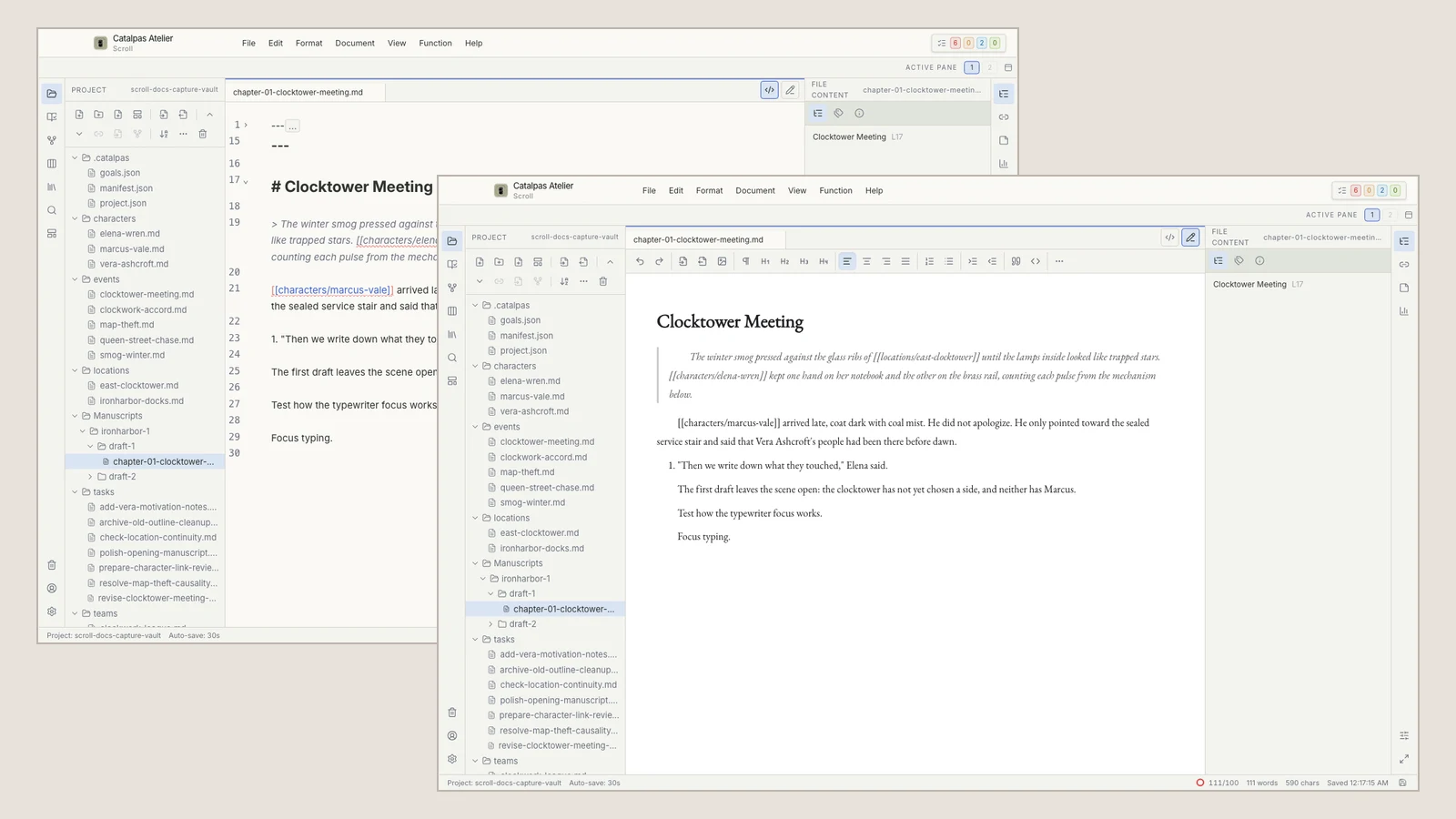
Scroll can import reference files into the current local Project. The imported item is a Project-managed copy; the external original is not changed, and later changes to that original do not automatically sync back. This preserves the material used at a particular creative stage, but it is not a live mirror of an external library.
Reference cards can hold a title, source information, Notes, and context specific to the work. Explicit links can connect a character, place, event, or manuscript passage to relevant material. Project search can find terms across the prose, card titles, and supported content. A link says that two places are related; it is not automatically a citation. An imported PDF does not create a bibliography record by itself.
Return to the temporary hospital. The writer imports the diary copy, records her summary under “night lighting,” makes the hospital a place, the supply shortage an event, and links the relevant chapter. Months later, a search for “kerosene” recovers both the wording in the draft and the research card behind it. The diary’s reliability and the need for formal citation remain authorial judgments.
Before delivery, an editor asks, “What supports this description of the shortage?” A download folder may force the author to reconstruct the entire search. A card containing the source, uncertainty, and chapter use lets her restore the earlier reasoning and decide whether to add evidence, narrow the wording, or remove an unsupported detail. The gain extends beyond faster retrieval; it reduces “research the whole book again” to “review one decision.”
Formal citation remains a separate responsibility. Notes, links, and search cannot stand in for full reference information. In nonfiction especially, a source can inspire the narrative without supporting a public factual claim, while background reading does not necessarily belong in the final bibliography.
Exploratory research can remain exploratory. Mindmap may group ideas, Flowchart may arrange a causal possibility, and Whiteboard may hold an uncertain lead. A canvas connection is a trace of thought, not a formal Story relation. When the judgment stabilizes, the writer can record the facts that deserve repeated checking in Story data or the draft.
A durable record also preserves how the author judged the evidence: access date, source type, questions about reliability, conflicts with other material, and intended chapter use. This does not require an academic record for every web page. It preserves the context that is hardest for a future writer or editor to reconstruct.
Interviews and private archives add permission boundaries. A tool can locate the material but cannot grant quotation rights, anonymize a source, or determine what is appropriate to publish. The writer still follows the Project’s agreement for permission, anonymization, and factual review.
Test a workflow backwards from one fact already in the manuscript. Can you find the author’s note, the Project copy used at the time, the external original, and the formal citation information? Where the chain breaks is where the next tool or working rule needs to add traceability.
Scroll suits a single Project whose research, Story data, prose, and revision tasks frequently affect one another. Zotero can remain authoritative for sources and citations; Obsidian for a cross-work knowledge network; Notion for visible research collaboration; Aeon for time calculation; and Scrivener for an established long-form Research project. Tools can coexist when the authority and handoff between them are explicit.
Continue with connecting research notes to the draft or explore the relationship between evidence and a complex plot in novel-planning software for complex stories. Return to the 2026 tool guide for other creative pressures.
The value of a research tool is not a larger collection. It is knowing what supports a statement when you write it. See the Scroll product page for its References, Project search, and manuscript context.