
Turn ‘finish the book’ into visible work
Separate story events from author tasks, then use Kanban, Calendar, Task list, and a bounded schedule to manage drafting and revision.
“Keep writing the novel” looks like a task. In practice, it is too large to complete and too vague to begin. Every session starts with another scan of the whole book: the motive in chapter three is thin, the journey from the capital to the border has not been checked, a promise from act two still needs a payoff, and the latest reader report added seven more notes.
The exhausting part is not the existence of unfinished work. It is the feeling that every unfinished thing must remain active in the author’s head.
A task board can move that cognitive load into view while allowing the novel to keep growing according to creative rather than administrative logic. Before creating columns, establish one boundary that determines whether the system will remain trustworthy: Story events answer “What happens in the work?” Writing tasks answer “What does the author need to do next?”
“The kingdom closes its ports on the winter solstice” is an event. “Make the port-closure date consistent in chapters three through six” is a task. “The heir rejects the alliance” is an event. “Strengthen the heir’s reason for changing sides” is a task. The former belongs to Story; the latter belongs to the author’s work.
Scroll lets a task point to related prose or cards, so the author can return from the work item to its story context without giving both records the same meaning.
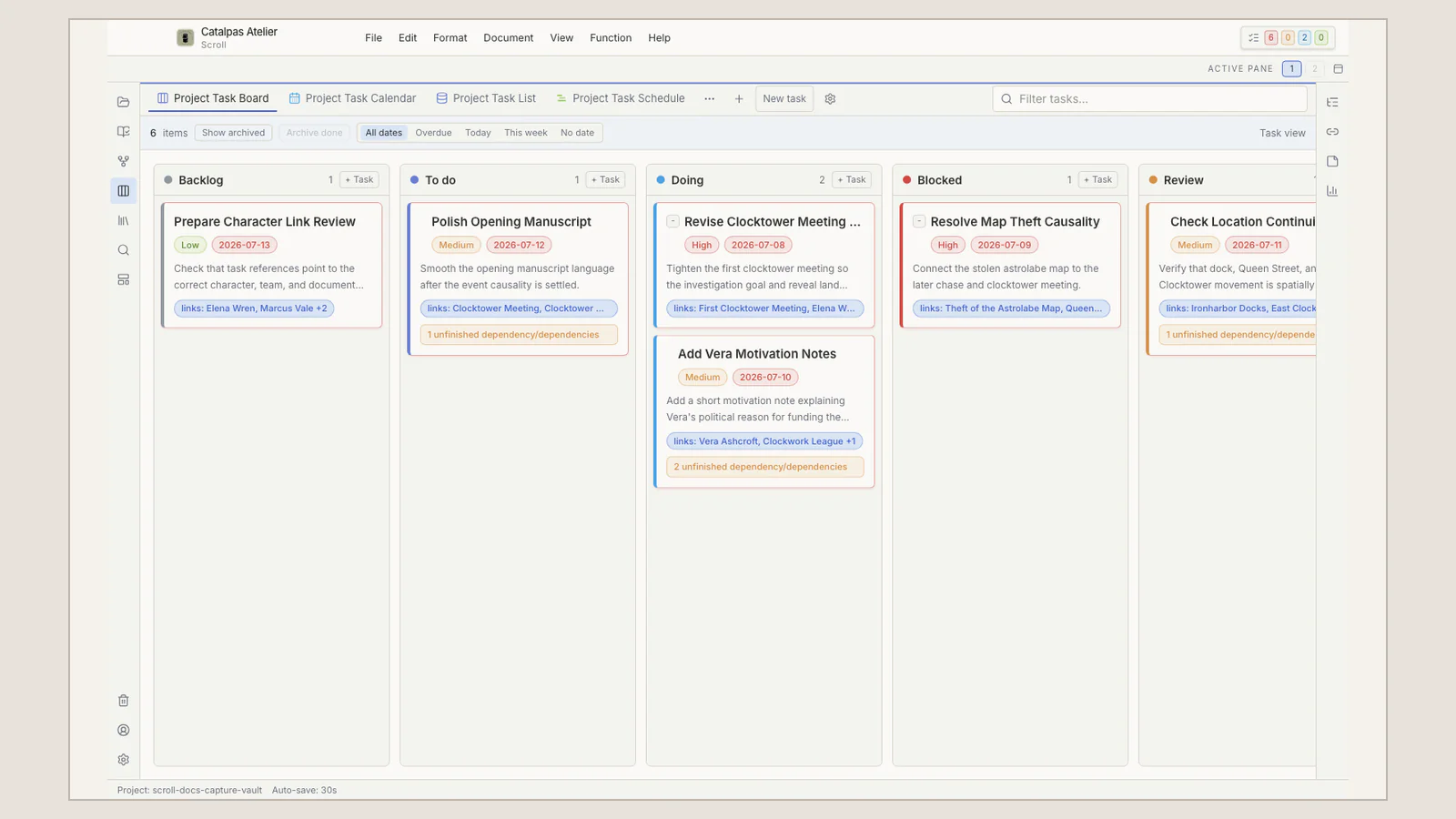
A useful task card begins with a verb
“Strengthen the heir’s motive in chapter three,” “check the journey from the capital to the border,” and “rewrite the opening of chapter eight after reader feedback” are more actionable than “chapter three” or “character motivation.” A verb turns attention from a problem area toward an action.
Then give the task a verifiable completion condition. For “check the journey,” completion might mean that related events use a consistent number of travel days, the manuscript’s departures, arrivals, and overnight stops have been reviewed, and any remaining uncertainty has been marked. This does not need to become a formal acceptance document. It needs to tell your future self when to stop.
Status and priority support the most basic choices. Dates, Parent tasks, and dependencies should appear when they improve a decision. A task can also link to a chapter or Story card, reconnecting “what needs work” to “why this work exists.”
Create a dependency when task B genuinely cannot be completed before task A. Deciding the journey duration may need to happen before correcting dates in several chapters. The fact that two tasks both concern time is not enough. Decorative dependencies add maintenance and can create loops without clarifying the work.
A Task Board matters because it limits work in progress
A minimal board may have four states: To do, In progress, Needs review, and Done or Archived. The labels matter less than whether each state can be judged consistently.
Many authors have begun too many things. Halfway through a chapter, they stop to check a historical detail. The research leads to a character restructure. A reader comment then sends them back to the opening. At the end of the day, five pieces of work have been touched and none have been closed.
A work-in-progress limit makes that choice visible. Before pulling in a fourth revision, can one current item be completed, returned to To do with a clear reason, or deliberately set aside? The aim is not an industrial productivity score. It is fewer expensive changes of context.
Swimlanes or Tags can distinguish drafting, research, and revision when those categories guide real choices. When the task volume is small, more classification may hide the next action. A board is useful to the extent that it mirrors how the author decides what to do. A beautiful dashboard that requires constant care can consume the writing time it was meant to protect.
Board, Calendar, List, and Schedule answer different questions
The same task can be inspected through several views without being copied four times.
Project Task Board shows status flow and work in progress. Which tasks remain in Needs review? How many items are already active?
Project Task Calendar asks about dates. Is this week overloaded? Which tasks are still unscheduled? Is there enough revision space between two external feedback rounds?
Project Task List makes fields and hierarchy easier to scan. Has “revise act two” been divided into actions that can actually be completed? Which items are missing a priority or a stopping condition?
Project Task Schedule places duration, milestones, and dependencies on a Gantt-style timeline. It can reveal a structural decision incorrectly scheduled after the chapter-level revisions that depend on it.
All four views work with the same Project tasks. Changing the window does not create four authoritative records. The principle resembles Story views: ask the question first, then choose the surface that can answer it.
Turn one revision week into a finite set of choices
Imagine an author planning the first structural revision of an epic fantasy. On Monday, she turns “repair the crisis in the capital” into seven pieces of work: strengthen the heir’s change of position, check travel time to the border, reconcile council dates, rewrite the siege opening, review the cost of magic, recover a dropped promise, and perform a final continuity pass.
All seven do not need to become active. She begins with the heir’s motive and the journey time, keeping work in progress within a range she can carry. When the first task is complete, she confirms that the related prose and Story records have actually been saved, then pulls the siege opening into progress.
On Wednesday, the journey remains blocked because the map scale is undecided. She records that reason in task Notes or related material, returns the task to To do, and continues with a magic-system check that does not depend on distance. At the weekend, she asks more than how many cards moved to Done. Were unfinished tasks too large? Was a dependency unresolved? Was priority wrong? Or was the Story fact itself still undecided?
Completed work can be archived instead of permanently deleted. Later, the author can see why a revision happened and notice which kinds of work keep returning.
One operational boundary matters: marking a task complete does not save the document it refers to. Task status records the author’s judgment about the work. It cannot substitute for saving an open file. Before ending the session, confirm that the relevant tabs and Project content are stored.
Do not let project management swallow the book
Task cards are for author work that needs tracking. A spelling correction that takes two minutes can be handled immediately. A fragment of an idea can remain in prose Notes or on the relevant card. Events in the story world belong in event cards.
Task dates help an author review plans inside Scroll, but they do not produce operating-system reminders while the app is closed. When a delivery date, interview, or team approval depends on a notification, a system calendar, reminder app, or collaboration service should continue to carry that responsibility.
Projects that require complex team approval, organization-wide permissions, or workflow automation may be better served by a general collaboration platform. Scroll’s Tasks workspace is centered on creative and revision work inside an author’s Project.
An author drafting linearly with very few outstanding items may need a small list rather than a board. Kanban becomes more useful when drafting, research, external feedback, and multiple revision passes overlap. The method should grow with the burden it is solving.
Make the next step small enough to begin
Try one short reset:
- Choose three items making the most noise in your head and rewrite each title with a verb.
- Add one sentence that defines when each item can stop, then link the chapter or card that gives it context.
- Pull one item into progress. Choose another after the first is complete or clearly blocked.
If task breakdown reveals that you have not decided what happens in the story, return to Why Does One Story Need 11 Views?. If the difficulty is how the Project records recurring facts, read Templates Are Not Story Formulas. Return to the Long-Form Writing Guide when you need to reassess the whole workflow.
The Tasks and writing progress guide and Tasks workspace reference document the exact public view and field boundaries. The editorial principle is smaller: let the board turn “finish the book” into one action that can begin today and reach a real stopping point.