
Worldbuilding tools for fantasy and science-fiction authors in 2026
Explore six tools for settings, relationships, maps, and timelines—and decide whether your world needs an enduring encyclopedia or Story data close to the draft.
A fantasy author has spent two years developing the states around a bay: seven currencies, three religious calendars, nine harbor families, and an old war that transformed continental trade. When her protagonist enters a border market, the writer stops. Finding the local currency is easy. Understanding how that institution changes the transaction, relationships, and conflict in this scene is harder.
Worldbuilding tools are good at answering “where does this information live?” A long novel also asks “how does this information affect the Story now?” Those jobs are compatible, but they create different centers of gravity. Some writers need an encyclopedia that grows across works. Some need a precise time model. Some want to design a knowledge network. Others want characters, places, and events in the current Project to participate directly in Timeline, Relationship graph, Map, and the draft.
The six tools below represent these different approaches. This is not a ranking by feature count. It is a way to decide whether the world’s primary responsibility is long-term preservation, specialist calculation, free connection, or service to the Story being written.
Worldbuilders often value two things at once. They want years of accumulated language, history, and cartography to outlive a single novel, while also needing the material to matter in tonight’s scene. The first need values an enduring asset; the second values proximity to the prose. Separating them helps a writer avoid maintaining a method merely because so much time has already been invested in it.
World Anvil: treat the whole world as an enduring asset
World Anvil provides articles, maps, family trees, diplomatic relationships, calendars, timelines, and whiteboards around a world encyclopedia. That “world before any one novel” structure is compelling for tabletop settings, transmedia projects, and universes that support several works. The setting can expand according to its own internal logic rather than the chapter list of book one.
It suits people who enjoy building, sharing, or presenting a world over time. A novelist still decides which facts belong in a public encyclopedia, which remain secrets of the current Story, and who carries the consequences of a changed chapter back into the long-term setting.
Campfire: combine writing and worldbuilding modules
Campfire organizes Manuscript, Characters, Timeline, and other creative modules within one writing ecosystem. Writers can emphasize the parts a work needs: one may begin with character, another with place and time, while another needs prose and planning together.
This modularity serves authors who do not want every novel to inherit the same heavy template. When evaluating it, look at how often your world information returns to scenes, chapters, and revision tasks, and whether material should remain shared across works or separate by book.
Fantasia Archive: a specialist home for offline worldbuilding
Fantasia Archive is a free offline worldbuilding tool. It organizes setting material through document types, bidirectional relations, hierarchies, tags, search, and sorting, and supports import and export for offline projects. It offers a focused direction for writers who want their material on their own machine within a purpose-built world structure.
Its value comes from organized records and relationships, not automated plotting. If it becomes the authority for the setting, establish a handoff rule: when do new manuscript facts return to the archive, do provisional facts from the current volume belong there, and what remains specific to the narrative?
Obsidian: let a local Markdown world grow freely
Obsidian’s Links, Backlinks, Graph, and Canvas can connect languages, histories, places, and people into a long-lived network. Local Markdown keeps that material in ordinary files, while themes, plugins, and open interfaces let writers shape the environment around their habits.
For people who enjoy designing systems, this is substantial freedom. When separate fictional worlds use separate Vaults, .obsidian configuration is also stored per Vault. Writers can copy common themes, plugins, templates, and shortcuts or maintain them through synchronization. The practical question becomes whether you want to maintain a large, adaptable knowledge base or open each novel to the same set of author-focused capabilities.
Aeon Timeline: when the world’s history must add up
If dynasties, voyages, character ages, and custom calendars determine whether the plot is credible, the world contains a time model as well as reference material. Aeon Timeline can place events, people, places, and arcs into temporal relationships and distinguish when events occur from the order in which readers encounter them.
That specialist depth suits work where a date error is expensive. It does not need to carry the whole setting or manuscript. The author can keep the time model authoritative and establish a clear naming and handoff practice with the reference library and writing environment.
Scroll: bring world information into the current Story
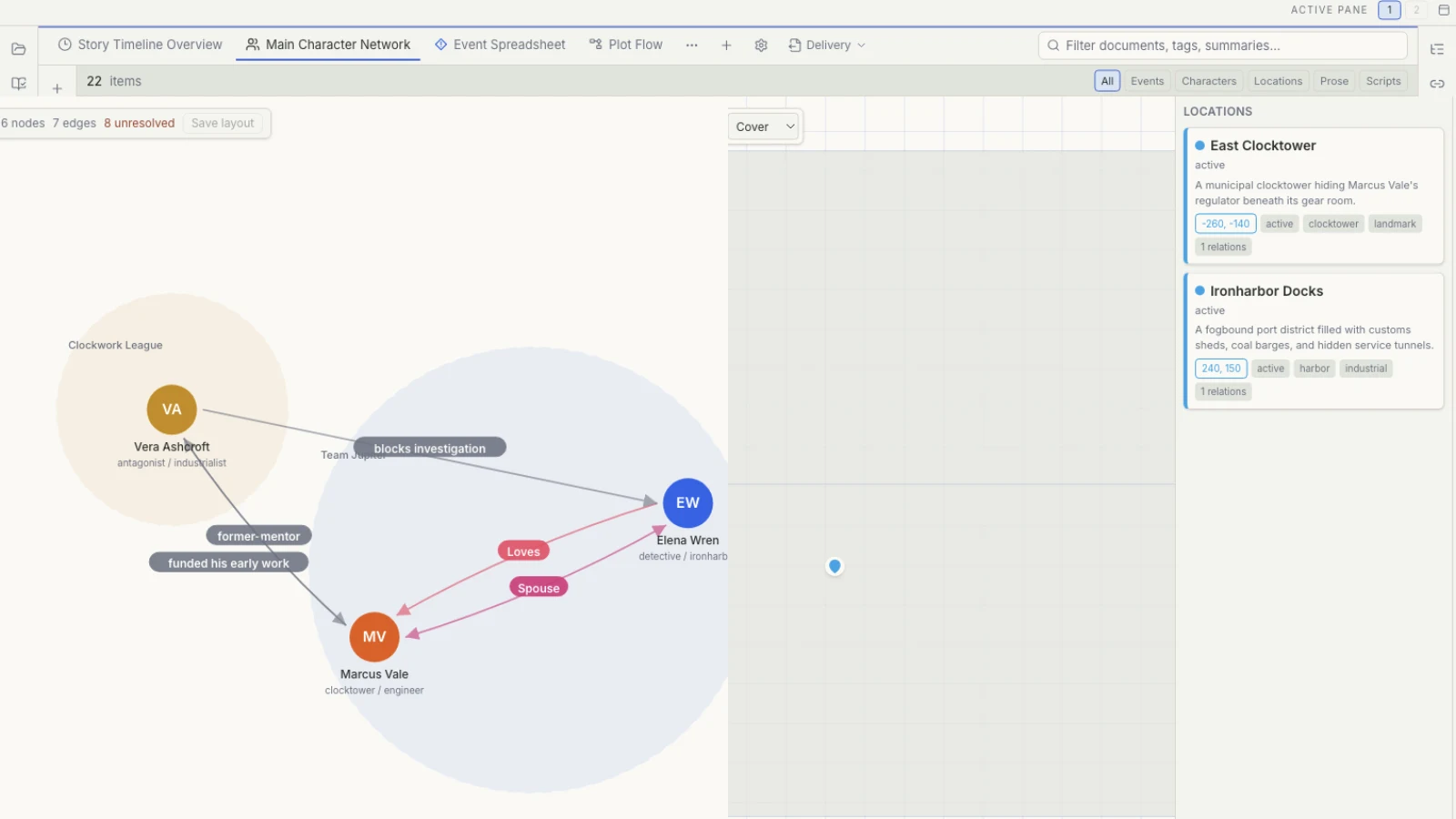
Scroll uses a local Project as its boundary. Characters, places, organizations, and events are Story data that can be inspected through Spreadsheet, Timeline, Relationship graph, Map, and other saved Story views without recopied people and events for each perspective. Mindmap, Whiteboard, and Flowchart suit exploration; their canvas connections do not automatically become structured relations.
Return to the border market. The writer makes the market a place, the merchants’ league and smugglers’ ring organizations, and the old war and currency reform events. She establishes relations explicitly, places locations on Map, and records event dates for Timeline. She still decides how the institution shapes the protagonist’s choice. Scroll does not understand the world for her or certify its consistency. It keeps the relevant context near the Story while she makes that judgment.
The benefit often becomes clearer in revision. The meeting moves from the border market to a river port. The author can revisit the participating organizations, the wartime limits on shipping routes, and the date of the currency reform, then decide which scenes also change. The information does not make the decision, but a change no longer ends at the boundary of one chapter. Worldbuilding becomes something the author can find again while revising.
Story data differs from an encyclopedia because it must serve the narrative. A property earns its place when it will be queried, filtered, or checked repeatedly. An ambiguous legend may belong in the prose. Structured cards do not ask the world to become a database; they provide a stable home for facts that affect several scenes.
Map is not an automatic geography engine. It can place location cards in a spatial working surface, but the author checks real distances and research. Relationship graph centers on explicitly recorded relations and can optionally add read-only connections derived from shared events and similar records. It does not read the prose or turn those connections into formal relations. These boundaries make each view more trustworthy: it answers a defined question without manufacturing a conclusion.
Test whether a setting serves the Story with one difficult scene. List the place rules, organizational interests, historic events, and character relations that change the choice before the protagonist. Information that changes action belongs near the current Story. Material that supplies distance and atmosphere can remain in an encyclopedia or research note. An idea with no present use need not be fixed early merely to fill a field.
Then close every setting page and explain in two or three sentences why this scene belongs to this world. If the answer is a list of proper nouns, the material may still be decorative. If law, geography, history, or relationship forces the character toward a cost, the world has entered the narrative. A tool shortens the route between fact and scene; the writer creates the connection.
A series adds another distinction: is a rule true across the world, or does it represent what a book-one character believes? The former may belong in a stable authority. The latter can remain in character Notes or prose. Separating setting fact from narrative knowledge keeps later volumes from being trapped by an early note.
An independent world may fit a long-term encyclopedia or specialist archive. A setting built on intricate dates may keep a dedicated time model. A writer who enjoys designing a personal system may prefer a Markdown network. Scroll fits Projects in which characters, places, events, research, and prose regularly affect one another and each work benefits from a consistent author workspace.
Continue with worldbuilding that serves the Story for a scene-level method, or read why one Story may need eleven views for the responsibilities of Timeline, Relationship graph, Map, and canvases. Return to the 2026 tool guide for other creative pressures.
A useful worldbuilding tool does not simply help you write more lore. It helps consequential facts appear when the Story needs them—and makes clear which blanks can remain open. The Scroll product page shows how these local Projects are organized.