
Worldbuilding is not an encyclopedia: bring setting back into the Story
When world notes grow but scenes remain blocked, use minimum Story data, explicit relations, Map, and Timeline to connect setting with character choice.
A fantasy author drafting the first volume of a trilogy has accumulated 50,000 words of worldbuilding: the harbor republic’s founding, its salt tax, seven family crests, a tidal calendar, and the former name of every street. Before a sample deadline, she must write an heir escaping a closed port. She still moves among several documents to answer three questions: Who can issue a night-sailing permit? Why would the merchants help her? How long is the journey from the old lighthouse to open water?
Abundant information is not the same as information that answers a scene. When worldbuilding grows according to “what else can I add?”, it can become an encyclopedia running beside the novel. It may look comprehensive without showing how a rule changes a character’s choice or when a piece of history returns to the plot.
For a long-form writer, the more useful question is: Which facts will I check repeatedly, and how do they return to the Story?
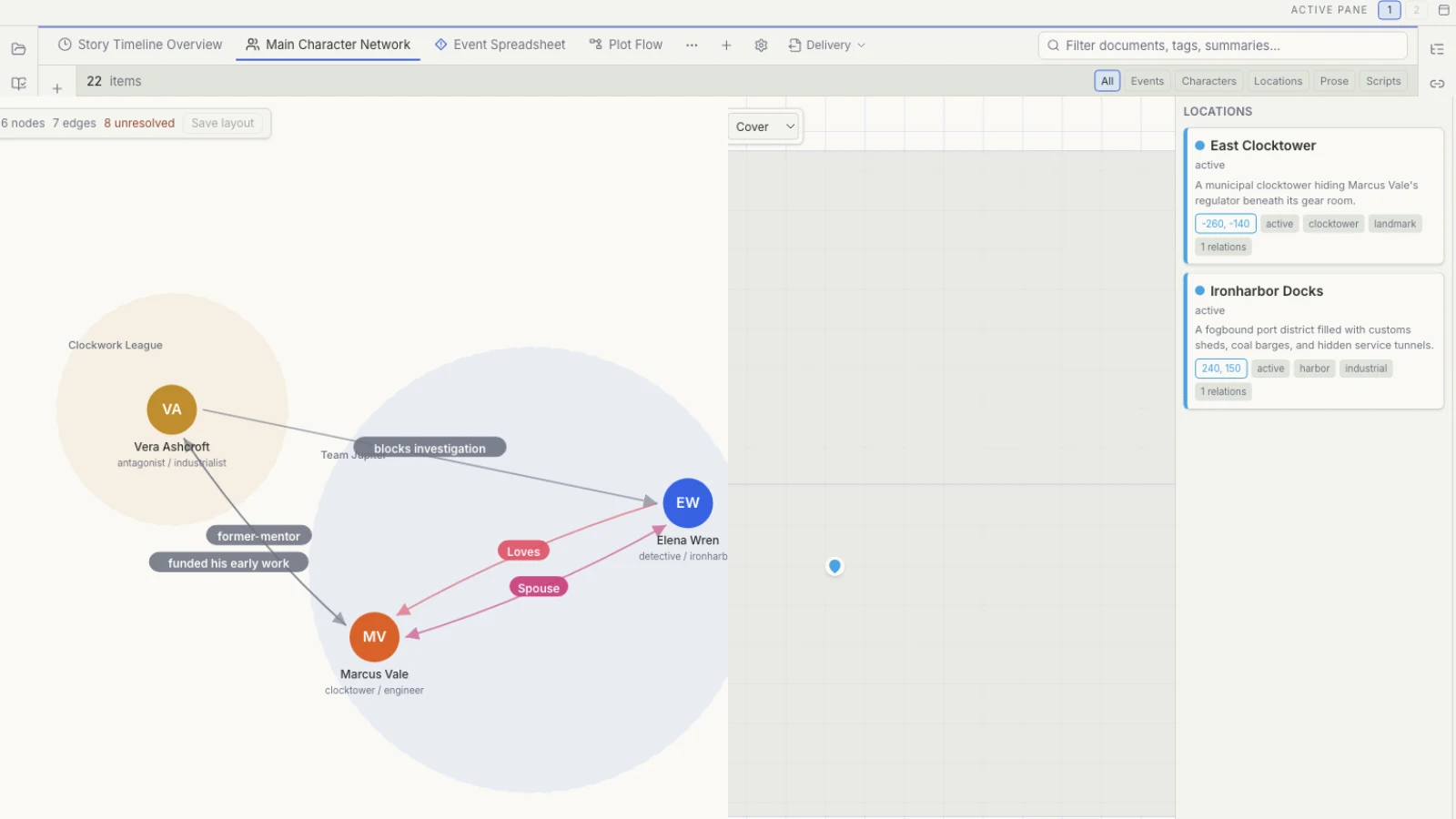
Build the smallest world that changes the scene
Begin with one blocked scene. List who is present, where it happens, which organizations hold power, which earlier event created today’s constraint, and what the character must pay for her choice.
In the harbor escape, the heir, harbor officer, and smuggler captain are characters. The lighthouse, closed docks, and offshore route are places. The merchants’ league and port council are organizations. The coup and closure order are events. A sailing prohibition that affects several chapters deserves a stable record. An old custom mentioned once for atmosphere may not.
That is the scale of minimum Story data: not everything the system can hold, but what the writer expects to check. A changing character goal can remain on a character card. A route distance that constrains several actions deserves a stable home. An uncertain cost of magic can stay in Notes or on a canvas. Let structure follow the Story rather than forcing premature answers into empty fields.
Match the form to the certainty
Confirmed facts and exploratory possibilities need different expressions. Otherwise, a temporary idea may return months later disguised as a settled decision.
The author can record explicit relations among characters, places, organizations, and events: the heir belongs to the royal house; the merchants control storage; the captain owes the harbor officer a debt. A manuscript link can bring context back when a chapter needs it. Whiteboard or Mindmap can hold “perhaps the merchants knew about the coup” while it remains a possibility.
A canvas connection is a trace of thought, not a formal relation. Two names appearing in one passage do not lead Scroll to infer trust between them. That boundary protects exploration and preserves a clear authority. When an idea stabilizes, the author decides whether it belongs in a relation or field.
Give each view one question
Scroll lets the same Story data appear through different Story views. Spreadsheet is useful for comparing recorded fields across many places or people. Relationship graph centers on explicit relations and can optionally overlay read-only connections derived from shared events. Map places location cards in a spatial working surface. Timeline shows event order from dates supplied by the author.
None of those views supplies the missing research. Map does not validate real distance. Timeline does not extract dates from prose. Mindmap, Whiteboard, and Flowchart support exploration. Subway can inspect the parallel participation and intersection of recorded events. A Project does not need every view; choose the one that addresses today’s question.
Read why one Story may need eleven views for the division among these perspectives.
The world enters the Story when it changes a choice
The sailing ban remains inert while it exists on a card. It becomes narrative when the heir has no legal permit, the merchants can forge cargo papers but demand the repeal of the salt tax, and the smuggler knows a tidal route through mines left by the old war.
Relationship graph helps the author inspect who might cooperate. Map keeps the route visible. Timeline shows where tide and patrol overlap. The old event explains why the danger exists. The author decides what the heir will sacrifice. The information does not write the Story; it gives each choice a common world of constraints.
After the chapter, that decision may update Story data. The merchants’ relation to the heir changes, the port closure gains a participant, and the lighthouse becomes a recurring place. Worldbuilding and drafting become a continuing exchange, not “plan everything, then write.”
The same exchange matters in revision. Move a meeting from a border market to a river port, and the participating organizations, shipping constraints left by war, and currency rules deserve another look. Scroll does not prevent the setting from changing. It helps the writer find the context affected by that change.
Use three small checks instead of an encyclopedia cleanup
Before drafting, inspect the characters, places, organizations, and events needed by the scene. When a new setting idea appears, leave it in Notes or an author task instead of abandoning the prose to finish its entire history. After the scene, promote decisions that now affect later work.
Ask three questions: Can the character get there? Is there enough time? Who will allow it under the relevant relation or institution? Map, Timeline, and Relationship graph provide material for those checks, but the author supplies the answers.
Hard science fiction may keep technical limits and research evidence in References with explicit links. Mythic fantasy may preserve contradictory legends. Structure does not require one objective account. The author can distinguish “world fact,” “a character’s belief,” and “an unresolved possibility” through a Project convention; Scroll does not infer those cognitive states.
Let enduring world assets and the current Project have different homes
A world may support a trilogy, short fiction, and a game. A specialist archive or cross-work knowledge base can remain authoritative for long-lived assets. The current Project can hold the Story data actually used by this book and explicit paths back to the authority.
The important thing is knowing which location counts. A stable law may belong to the long-term world source. A protagonist’s mistaken belief about that law belongs in character Notes or prose. A closure specific to book two belongs to that Work’s events. Separating these layers keeps a series flexible.
Use the worldbuilding tools guide to consider an encyclopedia, specialist time model, flexible knowledge network, or Story-centered workbench. Story templates without formulas explains how to keep a Project model restrained.
Views cannot prove that a world is correct, and cards cannot perform the research. Test the setting through the scene: does this fact change what the character can do, will do, or must pay? If so, it has become part of the Story. If not, it can remain in the distance without guilt.
For the author facing her deadline, success is not completing the harbor encyclopedia. It is making the merchants’ condition create a debt the heir must repay in the next chapter. Return to the Scroll long-form writing workflow for planning, research, revision, and version paths, or see how these elements work around one local Project on the Scroll product page.