
A sustainable distraction-free writing room
Use a clear goal, limited feedback, Mask, Typewriter, and a safe exit to build focused writing sessions you can repeat.
An author enters Black House, and the interface becomes quieter. Three minutes later, she is reconsidering an adjective on the previous page. Two minutes after that, she changes the font and text width. Before writing a new sentence, she has checked the word count for the third time.
The screen is quieter. Her attention has not returned.
That is the easiest misunderstanding to have about a distraction-free writing room: if enough controls disappear, focus will arrive automatically. But distraction does not live exclusively at the edge of the screen. It also comes from undefined work, excessive feedback, the impulse to repair older prose, and the pressure to produce an impressive number before the session ends.
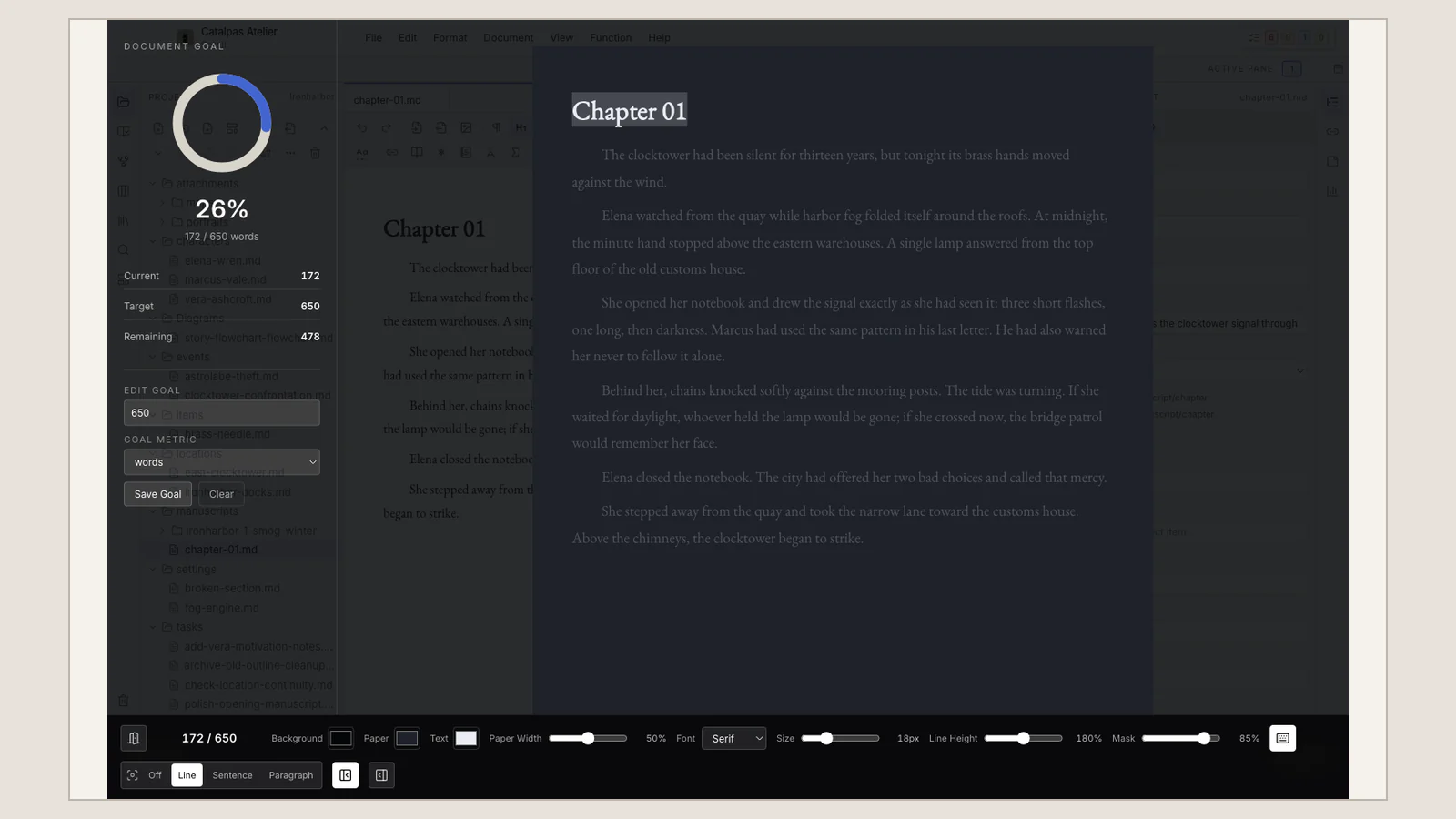
A sustainable focused-writing session needs more than a minimal interface. It needs four conditions: a clear entrance, one kind of work, limited feedback, and a safe exit. Scroll provides Black House, document goals, Focus Mask, Typewriter Mode, and editor appearance controls that can support such an environment. They are tools for attention, not judges of willpower.
Entrance: decide what this session is for
Before entering a focused environment, save the active document and confirm the chapter or text unit you are working on. The action is ordinary, but the boundary matters: the previous state is stored, and the new session begins from a known place.
Then reduce “write the novel” to a result that can be recognized within this session. For example:
- draft the turn from politeness to accusation in a reunion scene;
- rewrite the opening of chapter four so the protagonists enter conflict sooner;
- proofread chapter nine for names and punctuation.
Each is valid. They should not all happen in the same session. Drafting needs tolerance for uncertainty. Rewriting asks for structural judgment. Proofreading narrows attention to a chosen class of error. When an author drafts dialogue, corrects punctuation in earlier pages, and rearranges chapters at once, even a blank screen contains constant task switching.
A session goal should be small enough that progress can be judged: a conversation, a turn, or one particular review. Scroll’s document goals use words or characters. Character count may be more informative for languages that do not conventionally separate words with spaces. Revision may not benefit from a count at all; “rewrite the turn in this scene” can be a more truthful measure of the work.
A goal is where attention lands. It is not a grade. Three hundred words that finally make the scene work may serve the book better than two thousand words written to satisfy a number.
Limited feedback: keep what helps the current decision
Writing statistics can turn from feedback into noise. When words, characters, paragraphs, duration, and speed are all visible, the author may begin managing numbers rather than sentences.
Choose one main signal for a focused session. During continuous drafting, that may be character count or a time boundary. During a scene revision, it may be the stopping condition you wrote before entering. Let information unrelated to the current work leave the foreground.
The scope of the numbers also matters. Characters, words, and paragraphs in the editor do not predict the number of pages after Scribe typesetting. Book length on the page depends on trim size, fonts, spacing, paragraph styles, and other layout decisions. It is fine to say a writing day “felt like three pages.” It is misleading to treat editor statistics as a measurement of the future PDF or printed book.
Streaks and high counts should not become moral achievements. They help some writers establish rhythm and make others reluctant to return after a broken day. A more sustainable question is whether the feedback helps you continue the work in front of you. If it does not, reduce it.
Focus Mask and Typewriter Mode: manage the field of view, not the author
Attention is often pulled toward text outside the active paragraph. A phrase above seems imperfect; a gap below reminds you of a problem that has not been solved. Focus Mask can soften surrounding context so the current sentence competes with less text. It does not delete anything or ask the author to forget the chapter. It narrows visual competition for the present moment.
Typewriter Mode keeps the input position more stable as new lines appear. Writers who prefer a consistent reading height may find the rhythm calmer. When the work requires frequent context checks, or when a visual behavior conflicts with accessibility needs, turn off any setting that adds discomfort.
Font, editor width, color, and line spacing are also part of the writing environment. A narrower measure may make long lines easier to read. A softer contrast may suit evening work. Another author may need stronger contrast, a larger font, or a wider field. There is no universal “writer’s interface.” A useful setup makes the interface easier to forget.
These choices affect writing in the editor. They do not create a Scribe Appearance, paginate the manuscript, or produce a PDF. A dark background and narrow text column used for drafting can remain entirely separate from the paper, type, and page design of the finished book.
What a 45-minute session can look like
Forty-five minutes is an example, not a prescription. It is long enough to observe an entrance and an exit.
For the first five minutes, the author saves the active tab, opens the reunion chapter, and writes one goal: “Complete the turn from polite conversation to accusation.” She decides to draft rather than reorganize the whole relationship arc or repair naming problems elsewhere.
For the next thirty-five minutes, she selects Enter Black House, keeps an editor appearance that feels comfortable, uses Typewriter Mode, and turns on a Focus Mask that reduces the pull of older paragraphs. When the scene reaches a railway-station closure date that needs research, she leaves a clear marker and continues the emotional logic of the conversation.
During the last five minutes, she exits Black House, reads the new turn, saves the document, and leaves a concrete return point: “Next time, begin when he produces the letter he never sent.” If the research issue genuinely needs tracking, she records it through the Task Board for Novelists so the unresolved question has a dependable home.
The session could be twenty minutes or much longer. Some writers need timed breaks; others stop at a natural scene boundary. The method is not the number. The method is an entrance, one kind of work, and an exit that makes returning easier.
Different stages need different degrees of focus
Drafting generally benefits from less feedback and greater tolerance. Temporary markers, awkward sentences, and unverified details can remain while the scene moves forward.
Revision needs more context. An author may check linked tasks, neighboring chapters, and Story data before returning to the current paragraph. Black House can support the execution of a revision that has already been decided. It does not need to carry the entire structural diagnosis.
Proofreading narrows the field again. Reviewing names, punctuation, or one format issue at a time is easier to finish than “improve every sentence while you are here.”
Black House is therefore not the correct surface for every creative stage. Cross-chapter continuity, relationship checks, chronology, and structural rearrangement need the editor workbench, Story views, or Tasks. Delivery review also asks for more than the active paragraph.
If Focus Mask, Typewriter Mode, or another visual behavior conflicts with vision, attention, or assistive technology, turning it off is the right choice. Focus is not a visual style to imitate. It is a sufficiently low-friction relationship between the writer and the present task.
A safe exit matters more than forced persistence
Many focus methods describe how to lock the author in and say little about leaving. A useful exit includes three actions: save, identify what moved forward, and leave the next step.
An unfinished goal does not make the session a failure. The Story fact may still be undecided. The task may have been too large. The body may have needed a shorter session. Turn the reason into information you can act on: return to Timeline to confirm chronology, split the scene across two sessions, or stop and recover.
The Long-form writing and revision guide documents the current writing modes and focus tools. Continue with Visual Mode or Source View? when the next question is how the prose should be edited, or return to the Long-Form Writing Guide to distinguish a Story problem from a task or attention problem.
A focused session succeeds less by how completely the author disappeared from the world than by what was saved, whether the next step is clear, and whether returning tomorrow still feels possible.