
What is causing the rework: time, hierarchy, or worldbuilding?
Conflicting ages and dates, an outline with too many levels, and scattered world records are different problems. Learn how Aeon Timeline, OmniOutliner, Fantasia Archive, and Scroll divide specialist depth and an integrated writing workflow.
After a long work reaches one hundred thousand words, the most exhausting problem is often not a lack of ideas. It is rework.
A grandfather dies in volume one and becomes two years younger in volume three. A nonfiction outline grows from four levels to eight, until an argument no longer has a clear chapter. Currency, religion, and ports for a fantasy world are spread across dozens of notes and must be confirmed again in every scene. All three are called planning problems, but they are not the same problem.
If a character’s age can break the mystery, you need time calculation. If an argument disappears inside its own structure, you need hierarchy. If one world must serve three novels, you need a lasting reference asset. If people, events, locations, Tasks, and prose continually affect one another, you may need a main writing environment that preserves their shared context.
That is why Aeon Timeline, OmniOutliner, Fantasia Archive, and Scroll do not belong in one checkbox scorecard. Their value is not “the most features.” It is helping a particular writer avoid a particularly expensive mistake.
When the Story depends on time itself: Aeon Timeline
For a family history spanning three generations, a historical adventure shaped by travel time, or a fantasy series using its own calendar, Aeon Timeline offers more than a line with dates. Story timelines bring events, people and groups, arcs, locations, and narrative structure into a temporal model. The writer can examine the order in which events happen and the order in which the reader encounters them.
Its Story Math material addresses ages, intervals, durations, dependencies, relative dates, and other relationships that become difficult to maintain by mental arithmetic. If changing one birth date affects a wedding, an inheritance, and a later investigation, temporal calculation is the central work rather than an accessory view.
That specialist depth matters when chronology is the source of truth. The author can ask questions such as “How old was this person when the treaty was signed?”, “Could these journeys overlap?”, and “Does the narrative reveal this event before its cause?” with a system made for time.
Aeon also documents workflows with Scrivener and Ulysses. Those synchronization steps are explicit actions with defined fields and review requirements; they should not be described as a universal, automatic connection to every writing app.
If Aeon and Scroll coexist, the writer can designate Aeon as the chronology authority and use Scroll for the current manuscript, Story context, research, Tasks, and versions. Facts repeated in both places still need a named source and a deliberate update practice.
When the argument lives in its levels: OmniOutliner
Some books are difficult because their structure is the thinking. A scholarly chapter, policy argument, narrative nonfiction work, or branching treatment may need claims, evidence, counterarguments, examples, and notes to remain legible across many levels.
OmniOutliner is built to let that hierarchy expand. Rows can nest without a shallow fixed limit, branches can collapse and open, and notes and attachments can remain near the item they support. Columns, filters, themes, and writing modes let one outline operate as both thought model and working document. Its current product pages focus on the Apple ecosystem, including Mac, iPad, iPhone, and Apple Vision Pro.
For a writer who thinks by indentation, that depth is not a compromise on prose. The ability to move one branch and carry all of its children can preserve an argument that would be obscured by a flat chapter list. Filtering can isolate unfinished evidence. Columns can hold status or responsibility without forcing those values into the sentence itself.
An outliner is therefore a strong center when hierarchy is the work’s authority. If OmniOutliner and Scroll share a workflow, the outline can remain the structural authority while Scroll holds the manuscript and author workflow for the present Project. The handoff should state which outline version corresponds to which chapters, rather than assuming two structures will remain identical by themselves.
When the world must outlive one book: Fantasia Archive
A worldbuilding archive solves another problem. A monetary system, religion, language, dynasty, or city may belong to a world before it belongs to a particular chapter. It may need to remain available after one volume is finished and influence a later series.
Fantasia Archive describes itself as a free, offline worldbuilding and documenting tool that runs on the user’s computer. The original-creator download page currently offers Windows, macOS, and Linux downloads. Public material describes predefined document types and fields, two-way relationships, document hierarchy, tags, search, sorting, offline Project import and export, multiple document tabs, and customizable keyboard controls.
Those capabilities explain the appeal for “world first” writers. Setting records do not have to be subordinate to one manuscript. They can have their own classifications, relationships, and long-lived boundary. For a world reused across books, that independence may matter more than keeping every record inside the current novel.
Public pages can support current capabilities and download choices. They are not enough to infer an unannounced roadmap, future platform, or maintenance cadence. A writer deciding whether any tool will be the long-term authority should evaluate the current version, backup method, and recovery needs without turning unknowns into praise or criticism.
If Fantasia Archive and Scroll coexist, the archive can remain the authority for world assets shared across works. Scroll can hold only the characters, locations, events, and Tasks that actively shape the current volume. Any fact copied between the two still needs one named authority.
When the problem is how everything affects the manuscript
A historical-fantasy writer may face four pressures at once: a custom calendar must remain accurate, a trilogy structure needs to be rearranged, shared world records must survive across volumes, and two chapters still have to be written this week. No principle requires her to use only one tool. No principle requires four either.
She can let Aeon own chronology, OmniOutliner own the argument or series hierarchy, Fantasia Archive own the world, and a writing app own the prose. That route gains specialist depth. It also creates handoff points, naming rules, and repeated records that the writer must maintain. Multiple tools are reasonable whenever their maintenance cost remains lower than the rework they prevent.
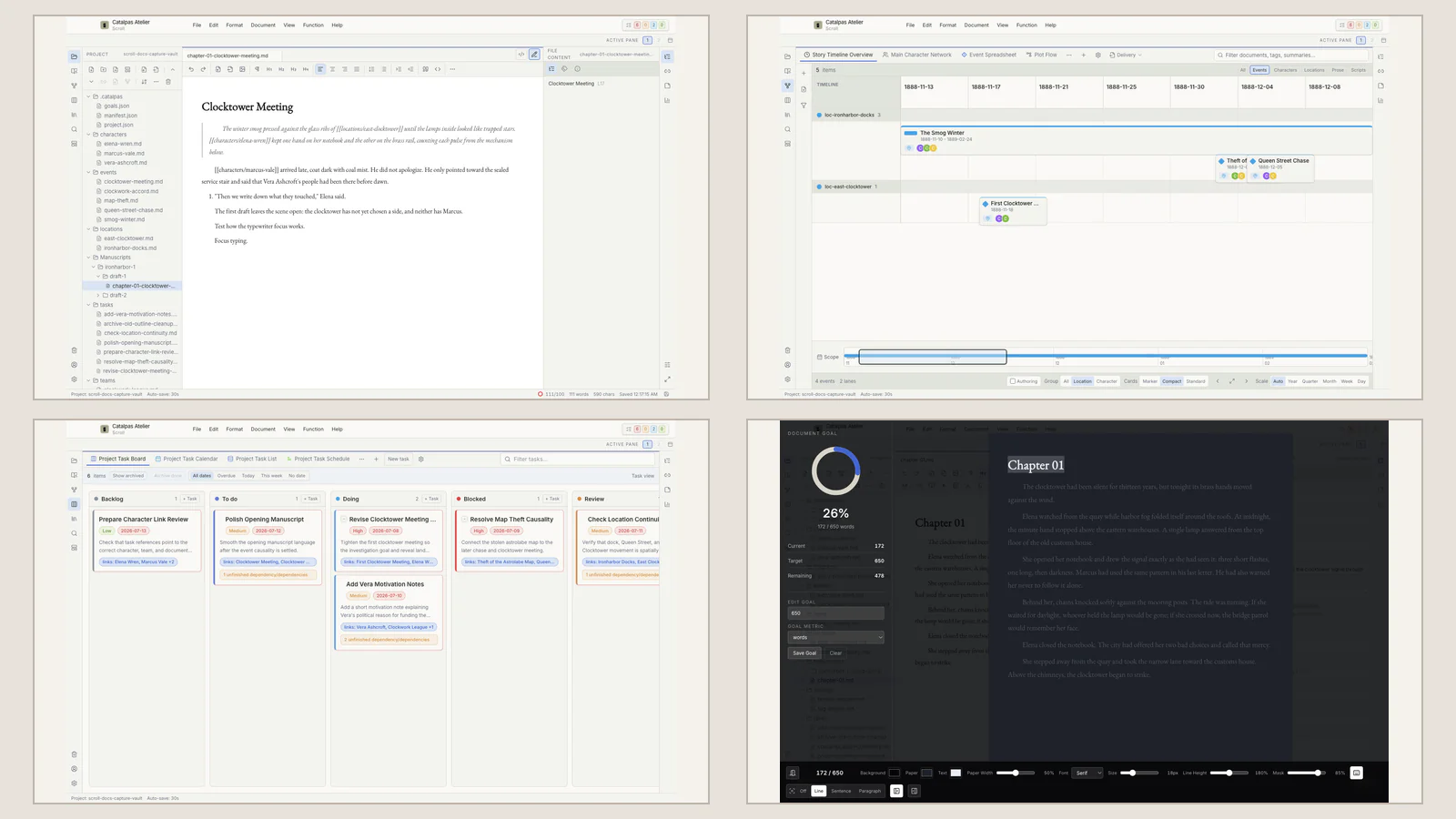
Another route is to make the current work a Scroll Project. Characters, locations, and events can be examined through temporal, relational, spatial, and canvas views. Manuscript text, research, author Tasks, works, and manuscript versions remain in the same local context. The advantage is not that every individual domain becomes deeper than a specialist application. It is that after changing an event, the writer has fewer disconnected places in which an old version may remain hidden.
When the plan becomes a book, a stable Scroll manuscript can continue through the Scroll to Scribe workflow into page design and publication output. That downstream division is part of an integrated author workflow; it is not evidence that Scroll has specialist chronology, outlining, or worldbuilding depth beyond the tools dedicated to those domains.
Use Aeon when custom-calendar and age calculation decide whether the Story works. Use OmniOutliner when the hierarchy itself is the intellectual model. Keep Fantasia Archive when the world is an asset independent of any volume. Use an integrated center when several kinds of context repeatedly need to meet beside the manuscript. The decision is where the current work should live each day.
Let the latest rework choose the tool
Think about the last mistake that genuinely stopped the draft. Was an age wrong? Did an argument lose its place in the outline? Could the writer not find a setting rule? Did one fact have three versions across prose, notes, and Tasks? That answer is more useful than a generic ranking of writing software.
If one domain determines whether the work succeeds, give it specialist depth. If several kinds of record must repeatedly be checked beside the manuscript, assess the value of an integrated workbench. If the current combination is already mature, calculate the cost of handoffs and double maintenance before changing it.
To see how Scroll views read one set of Story records, continue with Why One Story May Need Eleven Views. If you are not yet sure whether the present block lies in ideation, planning, or writing, return to the Scroll comparison guide or the Long-Form Writing Guide.
If the recurring cost comes from divided context, visit the Scroll product page to see how multi-view Story planning, a local Project, manuscript writing, Tasks, and versions can form one creative center—then decide whether this work needs specialist depth, integrated breadth, or a clearly governed combination.