
The clues are not lost: manage chronology and character knowledge
For mysteries with conflicting testimony or two timelines, separate actual events, character knowledge, and reader revelation before using views, search, and tasks.
A mystery writer has finished a 90,000-word draft and owes it to her editor in two weeks. A reader asks, “The journalist saw the letter earlier. Why does she wait until chapter sixteen to recognize the answer?” The sentence is indeed in chapter five. The clue has not vanished; the boundary around information has. When did the event occur? When did this character know it? When did the reader have enough evidence?
Mystery, crime, and suspense create tension through unequal information. The author knows more than the characters and readers while controlling each revelation. One clue list can still confuse three orders. A more stable revision begins by separating them.
This three-layer method is an editorial practice, not an automatic clue system built into Scroll. The author decides how to record the material. Scroll helps recorded events, people, relations, manuscript locations, and revision work become visible again.
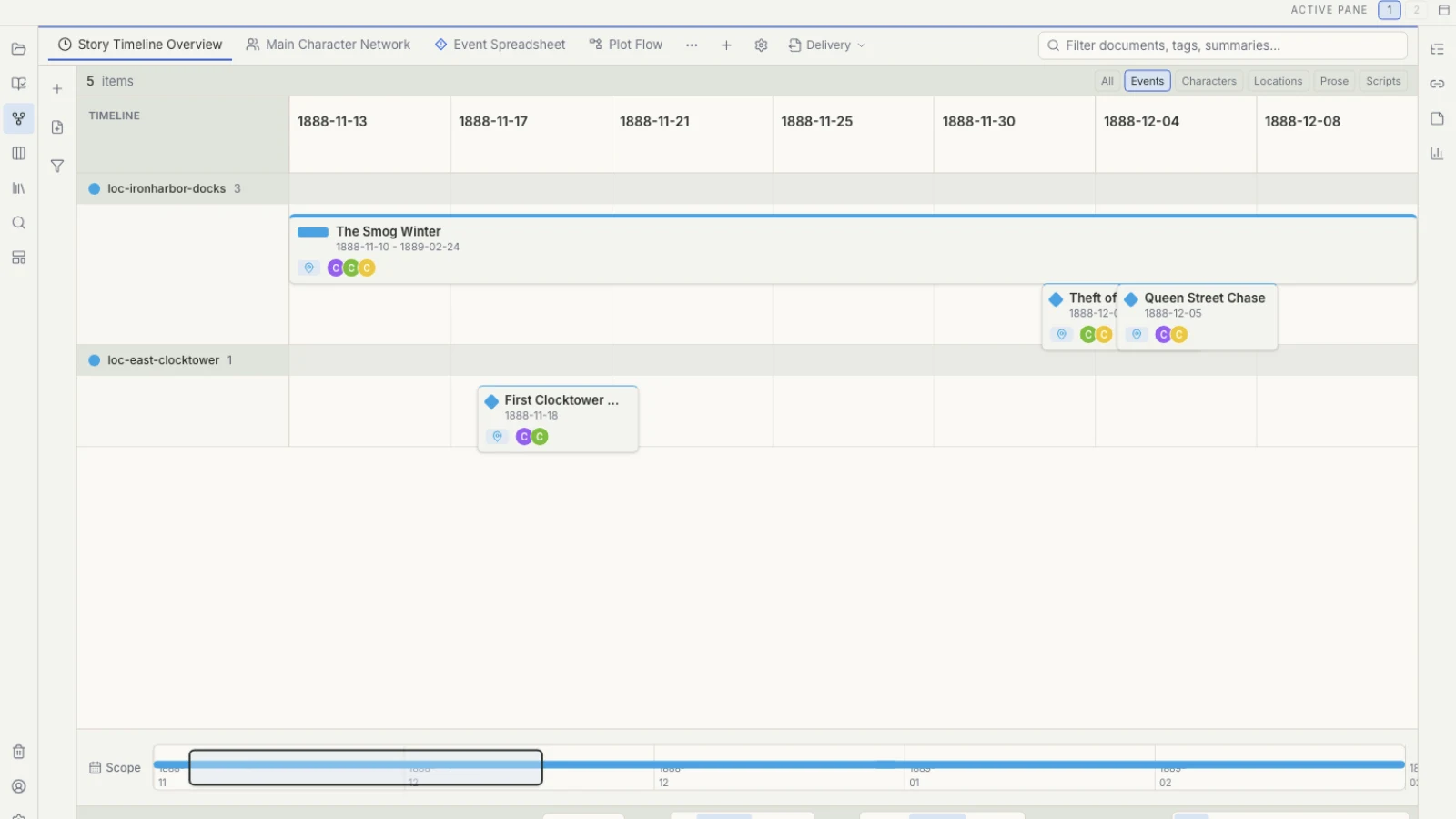
First line: what actually happens in the Story world
This is the case chronology. The missing person leaves the archive on Tuesday evening, reaches the old harbor early Wednesday, and has his signature forged on Thursday. However the novel rearranges those events, the writer needs an explainable causal chain.
In Scroll, event cards and Timeline can carry confirmed dates, participants, and places. Subway can help inspect how recorded character strands run in parallel and intersect.
Not every event needs a precise date. Deliberately uncertain time can remain in Notes or a custom field, with dates reserved for nodes that need temporal inspection. False precision makes a plan look full without helping the book. Story views show the information supplied by the author; they do not calculate the truth from the manuscript.
Second line: what each character knows
“A is related to B” does not mean “A knows B’s secret.” Relationship graph can display explicit family, allegiance, interest, or opposition and, when enabled, read-only connections derived from shared events. Neither kind of connection establishes what a character knows. Knowledge often needs the writer’s own fields, Notes, or notation.
For a consequential clue, record what matters: who witnessed it, who heard it secondhand, who believes a false account, and when a judgment changes. Scroll does not read the manuscript and infer character knowledge, nor does shared participation in an event mean that everyone shares all information.
A compact knowledge record may contain the proposition, how the character acquired it, when, and the current degree of trust. A person can hear the truth and reject it or act rationally on false information. Track knowledge states that change action or suspense.
Third line: when the reader learns it
Event order and reading order can diverge. A crime occurs on Tuesday; a prologue shows Friday’s body; chapter four returns to Tuesday; and chapter ten reveals the archive-door failure. Chapter order, viewpoint, and omission shape the reader’s experience.
During revision, work backwards from a revelation. What evidence has the reader encountered? Which details are atmosphere? Who is lying, and has the narrative left a fair basis for judgment?
Software can locate related chapters, events, and people. It cannot evaluate whether the solution is fair or the misdirection excessive. Those remain judgments for the author, editor, and readers.
Carry one changed statement through all three layers
In the harbor case, a dockworker first says no vessel left on Tuesday night, then admits seeing an unlit freighter. The event layer records the vessel’s time, place, and participants. The character-knowledge layer records what the dockworker saw, what the smugglers knew, and that the journalist does not hear the correction until chapter eight. The reader layer records the first testimony in chapter three and the motive for the correction in chapter eleven.
After moving the event one day earlier, the writer checks the freighter against the tide in Timeline and reviews which character actions change. Project search finds “unlit freighter,” an earlier name for the vessel, and placeholders in the prose. She turns “revise the journalist’s inference in chapter five” and “check the testimony wording in chapter eleven” into separate tasks.
The reader’s letter can follow the same path. The problem is not its delivery date but that chapter five reveals too much. The writer lets the journalist see a partial copy there and receive the full text from the archivist in chapter eight. A search for the letter’s former name identifies two chapters and one character Note for review. The reversal survives, and the earlier evidence gains a new explanation.
Search returns text locations, not narrative meaning. A hit may be a clue or a metaphor; two people may share a name. The author opens each context before deciding what changes.
Turn the result into bounded revision work
A single date can make a mystery feel as though the whole book is broken. Keep Story events as descriptions of the case and author tasks as actions for this revision: “check every harbor scene from Tuesday to Thursday,” “rewrite how the journalist obtains the access record,” or “confirm two fair clues before chapter ten.”
Tasks can appear in Kanban, Task list, Calendar, or Gantt and link back to relevant chapters and cards. Limit work in progress so one causal chain closes before another opens. Completing a task does not prove that the manuscript was saved or every affected passage checked; end the pass by inspecting the prose.
Read the information boundary three times
First, read events in actual order without chapter order. Does cause and effect hold? Could each person be present? Second, follow one character and check what she sees, hears, believes, and conceals. She cannot act on the author’s knowledge. Third, read in reader order and examine whether each revelation has enough evidence and plausible misdirection.
These passes need not happen together. Give each one a limited task set and saved Story view. Fix actual chronology before character knowledge, then adjust reader experience. It is easier to close a layered revision than to perform detective, suspect, and reader roles in one pass.
At the end, ask a reader one question: what did you believe before the reveal, and which passages created that belief? Human reading experience can then be compared with the author’s recorded events, knowledge states, and manuscript locations.
Dual-timeline stories also need a distinction between when an event occurred and when a narrator looks back. A term learned later may appear in a memory as an intentional narrative voice or an accidental leak. Search finds the term; the writer judges the narrative layer.
See a Kanban workflow for novel-writing progress for the division between Story events and author work, and a structural revision workflow after the first draft for a larger second-draft pass.
Timeline makes sequence visible, Relationship graph makes recorded and optionally derived connections visible, search makes wording locations visible, and tasks make unfinished work visible. They do not extract clues, catch lies, diagnose plot holes, or solve the author’s case.
That limitation protects the central craft of mystery writing. The author knows the truth, decides how much each character knows, controls what the reader sees, and gives every silence a reason. Continue with novel-planning software for complex stories or why one Story may need eleven views.
When the three information layers can be explained separately, the writer gains freedom rather than a “no plot holes” certificate. Return to the Scroll long-form writing workflow for research, revision, and version paths, or explore the working surface on the Scroll product page.