
After the first draft: a structural revision workflow for long novels
When feedback covers the whole manuscript, define one structural question, inspect it through focused views, and turn it into bounded cross-chapter work.
The day after finishing a 100,000-word draft, a novelist opens feedback from three readers. Act two is too long. Three viewpoints have uneven motivation. The disappearance date may conflict with another chapter. Chapter nineteen feels like the true beginning. The submission window closes in a month. Each note is plausible; together they seem to say that the entire book must change.
The hardest part of structural revision is turning a problem into work that can end. Starting at page one with line edits does not shorten act two. Changing pace, character arc, worldbuilding, and language together means each decision may be overwritten by the next.
A safer starting point is one sentence: Which structural question will this pass answer?
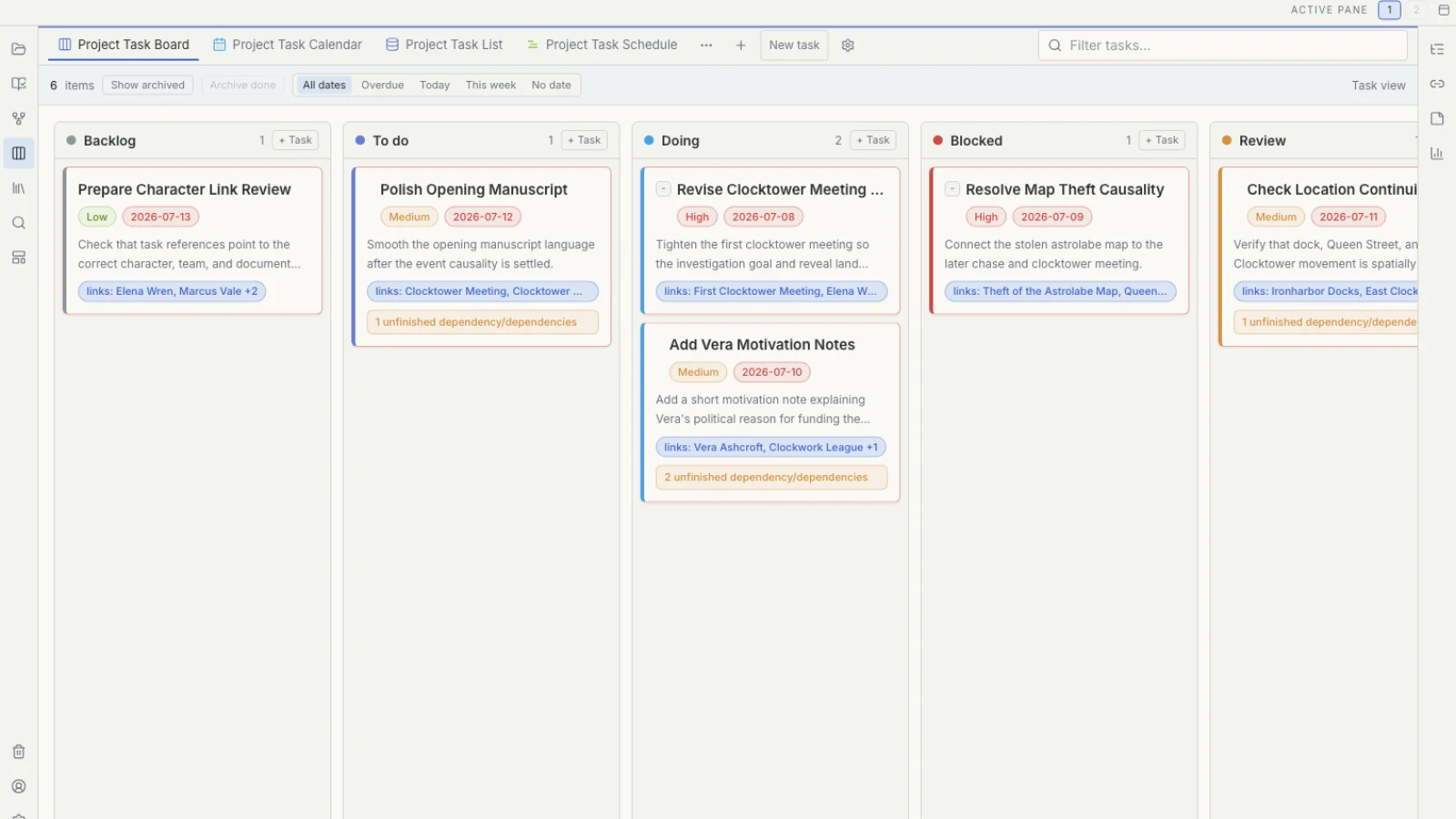
Choose one axis before revising the first sentence
“Act two is too long” is still broad. It may mean the goal arrives late, several investigation scenes repeat, one viewpoint goes inactive, or explanatory chapters accumulate before the climax. Narrow it to an observable question: “Across chapters nine through eighteen, does each chapter change the direction of the investigation?”
Choosing one axis does not dismiss other feedback. Put voice, date conflicts, and research gaps into later tasks. Conflicting comments also need not become a vote. Translate “too slow,” “the change is abrupt,” and “not enough context” into questions: Which chapters add no action? Which choices precede the change? Where does the reader receive necessary context?
Feedback describes symptoms. The writer chooses the diagnostic question.
Story views are lenses, not diagnoses
Scroll can show recorded Story data beyond chapter order. Spreadsheet can compare event goals, participants, or status. Timeline checks dates and sequence. Subway can inspect how recorded participation in several character strands approaches and intersects. Relationship graph centers on explicit relations and can optionally overlay read-only connections derived from shared events. Whiteboard can hold a provisional causal rearrangement.
None declares that act two is too long or detects a plot hole. Ask the question first, then choose the view. To check investigative progress, record the new action contributed by each relevant event and inspect repeated patterns. To check a viewpoint’s absence from story-time events, Subway may help. To check intervals among POV chapters, return to the manuscript tree and chapter order.
The writer may notice that chapters eleven, thirteen, and fifteen all repeat an archive search without changing a choice. That conclusion is editorial. A view helps place the scattered chapters under the same question.
Convert the diagnosis into bounded cross-chapter tasks
“Fix act two” has no visible endpoint. “Combine the archive discovery in chapters eleven and thirteen,” “give the second viewpoint an irreversible choice in chapter fourteen,” and “check the investigation change in chapters nine through eighteen” do.
Connect tasks to the relevant chapters and Story cards, then inspect them through Kanban, Task list, Calendar, or Gantt. Use task Notes to retain the reason for the change, its completion condition, and passages excluded from this pass. A writer returning three days later can recover the editorial intention rather than reread every comment.
Keep two or three tasks in progress. Close chapters before opening five more. Marking a task done does not mean the document is saved or the question answered; inspect the prose and unsaved state before closing the Project. This work-in-progress limit is the writer’s method, not a rule imposed by Scroll.
See a Kanban workflow for novel-writing progress for the division between Story events and author work.
Keep editorial judgment near the prose without making it prose
Structural revision produces text that does not belong in the book: reader feedback, reasons to remove a scene, research questions, and character-arc hypotheses. Notes can hold those judgments. Related Files or structured relations can connect a task to chapters, people, or events. An ordinary manuscript link can navigate to another Project file.
The forms may point to the same chapter without carrying the same meaning. “This scene must happen earlier” can remain a Note until the decision stabilizes. Then the author changes the actual manuscript.
For a focused session, save first and open the chapters required by the current task. Black House, Mask, and Typewriter support attention; they do not make the editorial decision. Editor Appearance does not become the book’s Appearance. See a sustainable distraction-free writing room for that boundary.
Understand file actions before restructuring the manuscript
Some structural decisions must change files. Scroll offers split, chain, append, and merge actions, and their effects differ: some support continuous reading; others alter a source or collect content in a target. Use the current long-form writing and revision documentation for the public behavior. Save the manuscript, back up the entire Project, and use a copy to test any uncertain result.
A three-viewpoint novel might first chain three chapters for continuous reading, then split out the viewpoint that must appear earlier. After the revised sequence works, the author can decide whether to merge repeated material or append while preserving an original. Each operation serves one editorial question and ends with a review of order, joins, and links.
Give the pass an ending
Recheck chapters nine through eighteen against the chosen question. Search for stale placeholders. Review related tasks. Then archive finished work and carry untouched feedback into the next pass.
After a split, merge, or move, inspect the seam: pronouns, time cues, entrances, heading levels, and links may still reflect the old structure. Read one chapter before and after the change, then search for terms from removed scenes. If an external editor touched the files, resolve any competing saves before continuing.
Leave a short record of the pass: the question, changes accepted, feedback deferred, the entry point for the next pass, and the location of the backup. This record tells the future writer why a choice was made and confirms that the pass has actually ended.
The novel may still need line revision, factual review, proofreading, and version confirmation. The accomplishment is an explainable structural result rather than several open edits. Continue with why one Story may need eleven views or establish the next boundary in manuscript versions and whole-Project backups.
Scroll supports the changing context of Story data, tasks, and prose. It does not make the judgment. When the manuscript is stable, Scribe takes responsibility for Appearance, pagination, and publication output. Return to the Scroll long-form writing workflow or explore the Scroll product page.