
Scrivener can hold the whole manuscript. What else must a complex story reveal?
Scrivener builds a mature long-form environment with Binder, Corkboard, and Research. When time, relationships, places, and evidence begin to interact, see how Scroll uses multiple Story views to help a writer inspect the whole work.
For a long-time Scrivener writer, the Binder is rarely just a file tree. It remembers which chapter belongs to whom, which discarded passage may still be useful, and where a piece of research is likely to matter again. Moving index cards on the Corkboard reshapes the draft. Outliner brings synopsis and metadata into view. Scrivenings reconnects separate pieces for continuous reading.
One of Scrivener’s lasting contributions is its early recognition that a book does not grow like an ordinary document, evenly from page one to the end. Research keeps source material close. Snapshots preserve a way back during long revision. Compile turns a complex writing project into distributable outputs. For many novelists, these are not isolated features but a long-form method that has become muscle memory.
Then the next book asks a different set of questions.
The chapters are in order, but do two events on Tuesday conflict? At what point does each of four viewpoint characters learn the secret? What shared inference depends on the harbor map, a court judgment, and an interview? The writer has not lost the research and does not need help moving scenes. She needs to look sideways across the chapter sequence—at time, relationships, space, and evidence.
As a novel becomes more intricate, these questions hide between individually reasonable notes. Each record can be correct on its own while the assembled Story contradicts itself. What the author needs is not another disconnected spreadsheet, but several ways to examine the same work.
This is the writing environment Scroll is designed to provide. The manuscript remains a manuscript inside a local Project. Characters, locations, organizations, and events can become Story data that different views inspect. A relationship view does not require a second cast list, and a Timeline does not require another event ledger. The writer changes the lens, not the source.
If you would rather begin from your existing working habits, return to the Scroll comparison guide. The question here is how a complex long work moves from “every chapter is present” to “the whole Story is visible.”
Complexity starts to run across the manuscript
A chapter list is naturally vertical: chapter two follows chapter one, and one scene follows another. Readers enter the story in that order. Revision often cuts across it. The writer follows one character’s choices, one promise and payoff, or every event inside a three-day window.
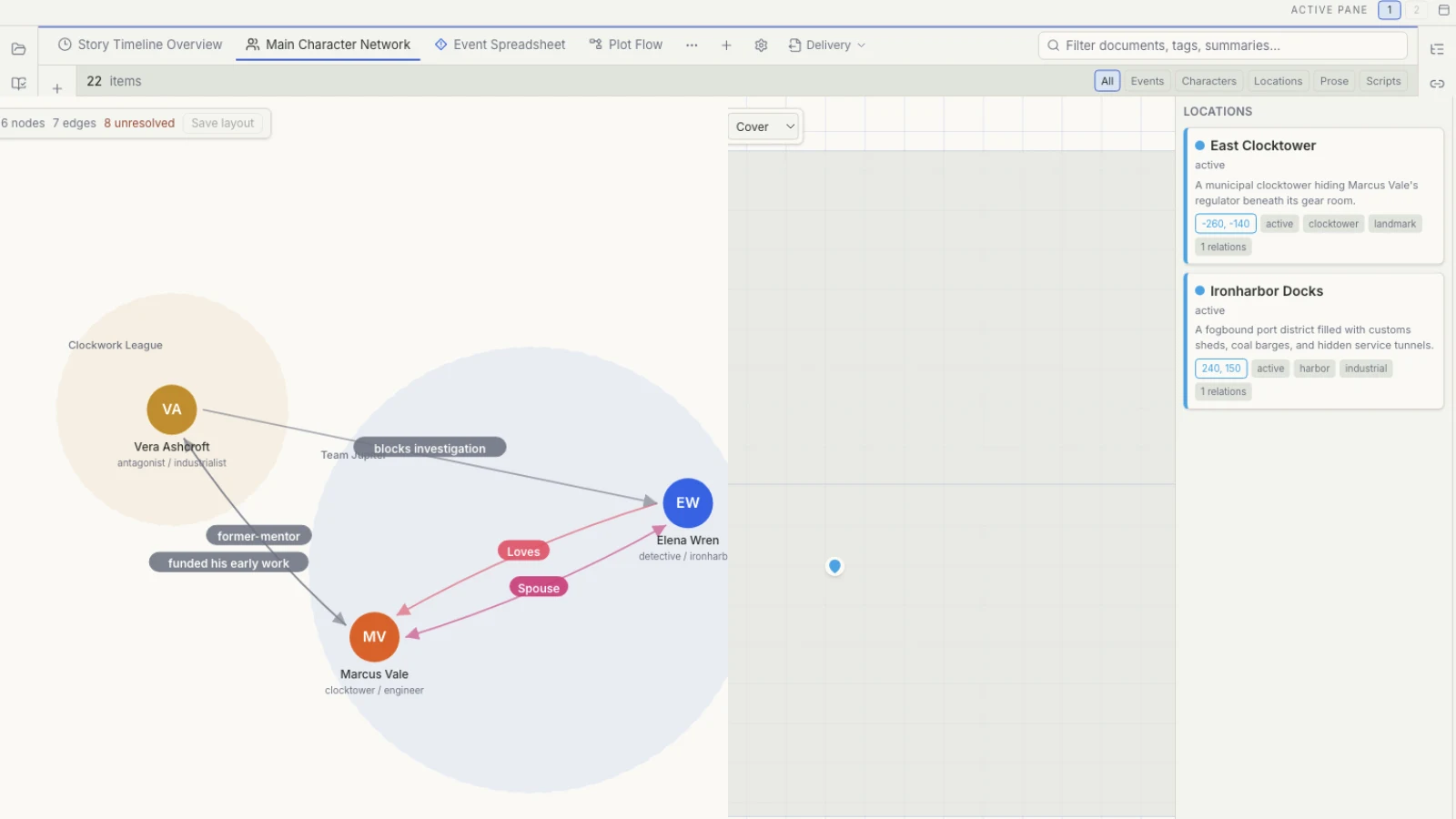
Scroll gives those transverse questions different working surfaces. Spreadsheet supports field review and filtering. Gallery makes people and places recognizable as cards. Calendar and Timeline expose dates and sequence. Subway helps follow intersecting narrative lines. Relationship graph shows relationships the author has explicitly recorded. Map and canvases support spatial questions, clues, and connections that are still being explored.
Those views do not require the writer to turn the novel into a database. Only facts worth checking repeatedly need to become Story data. Voice, ambiguity, and intuition can remain in prose and notes. Structure should reduce memory load, not prescribe the shape of the story.
Consider a harbor mystery with four viewpoint characters. The crime occurs early Saturday morning, the first twelve chapters alternate perspectives, and the solution depends on what each person knew at a particular time. The writer can check testimony on the Timeline, see where four character lines approach on Subway, then return to the manuscript to decide what readers should learn. It is one work examined through a series of precise questions.
That is the useful modernity of richer views. The author does not need to translate each new question into an improvised external table and then wonder whether the table has fallen behind the manuscript.
Research needs to participate in reasoning, not merely remain filed
Research-heavy books accumulate a gentle anxiety: everything was saved, but the writer no longer remembers why. A photograph of a building, an oral history, and an old shipping record may each be correctly stored. During revision, what matters is recovering their relationship to a character, place, event, or inference.
For a mystery set in an old port, the author can bring charts, court documents, and interview notes into the current Project as reference material. Explicit links in prose and cards can keep a source near the clue or place it informs. Project search helps recover the context later. Mindmap, Whiteboard, and Flowchart offer working space for material whose meaning is not settled: group records by location, arrange evidence along a causal path, or leave one uncertain clue at the edge of the canvas.
Confirmed information can then enter stable characters, places, and events. The writer remains responsible for reading, judging, and building the connections. Scroll does not understand an archive automatically or invent an inference. It helps research move from “I know I saved it” to “I can see which part of this work it is informing.”
For historical fiction, investigative nonfiction, and research-dense fantasy, visualization is not decoration. It can bring the right material back when the writer enters a location, trace the evidence behind a motive, and let a future self recover the reasoning that shaped the draft.
Story time and writing work need separate clocks
A complex novel contains two kinds of “what happened.” In the Story, a ferry leaves at dawn, a witness changes her statement before noon, and a suspect reaches the station that evening. In the author’s work, the ferry schedule must be checked, the witness needs a stronger motive, and chapter eight needs a new rhythm.
Mixing both in one card system seems economical until Story facts and production status begin to interfere. Scroll keeps events in the Story world and author work in Tasks. Board, Calendar, List, and Schedule can organize revision, priorities, and work in progress without turning a fictional event into a production ticket.
This division makes focused writing more concrete. Black House, goals, line focus, and typewriter mode protect the writing interval. Tasks remember questions that should not interrupt the current scene. A chronology doubt can become a traceable item instead of an immediate detour.
Focus is no longer only a hidden interface. It is the confidence that the Project will remember unfinished work. Continue with A Sustainable Distraction-Free Writing Room and A Novelist’s Kanban for Visible Progress for that rhythm.
A stable manuscript can continue into book production
As the work approaches completion, the central questions change again. Which chapters form the intended manuscript? Which version is entering production? Which source remains authoritative if the book is revised later?
Scroll keeps works, manuscript versions, and author decisions close to the local Project. When a version is stable, Scribe can take responsibility for Appearance, pagination, and publication output. Scroll does not generate the finished PDF, EPUB, or print layout, and a ready state does not prove that Scribe has received the manuscript correctly. The author still selects the scope and verifies recognized works, versions, chapters, and pages.
The division is useful because the writing environment can remain a place for Story reasoning and revision, while book production receives a deliberate source. See the complete boundary in the Scroll to Scribe workflow. If your search is specifically about Scrivener’s Compile and making a book, continue with Scrivener and Scribe.
Choose the next lens, not a winner
A short linear work may need a folder, a Corkboard, and uninterrupted prose. A chronologically intricate novel may need several views reading the same Story data. Research may need to become visible beside the inference it supports. Revision work may need its own system. These are questions created by the work, not a score assigned to the writer’s current tool.
Scroll’s role is to bring multi-view Story planning, research, manuscript writing, Tasks, and versions into one local Project, then preserve a clear downstream boundary for Scribe. The author still decides which facts deserve structure, which ideas should remain provisional, and which manuscript becomes the book.
Visit the Scroll product page to see how one Project moves among Timeline, Relationship graph, Map, canvases, writing, and Tasks. If the manuscript is already organized but the Story is becoming hard to see across its chapters, the next useful step may simply be a better lens.